Anchor Grids · Beta
Practice with grid bot paper trading
Practice Anchor Grids with simulated funds. Learn how paper bot slots, wallet balances, trading fees, and live trading differ.
Paper bots use simulated funds
Paper trading lets you explore the bot workflow without placing real exchange orders. The paper plan is a paid subscription. Your simulated holdings are separate from the funds in a live exchange account.
Choose the holdings you want to practice with
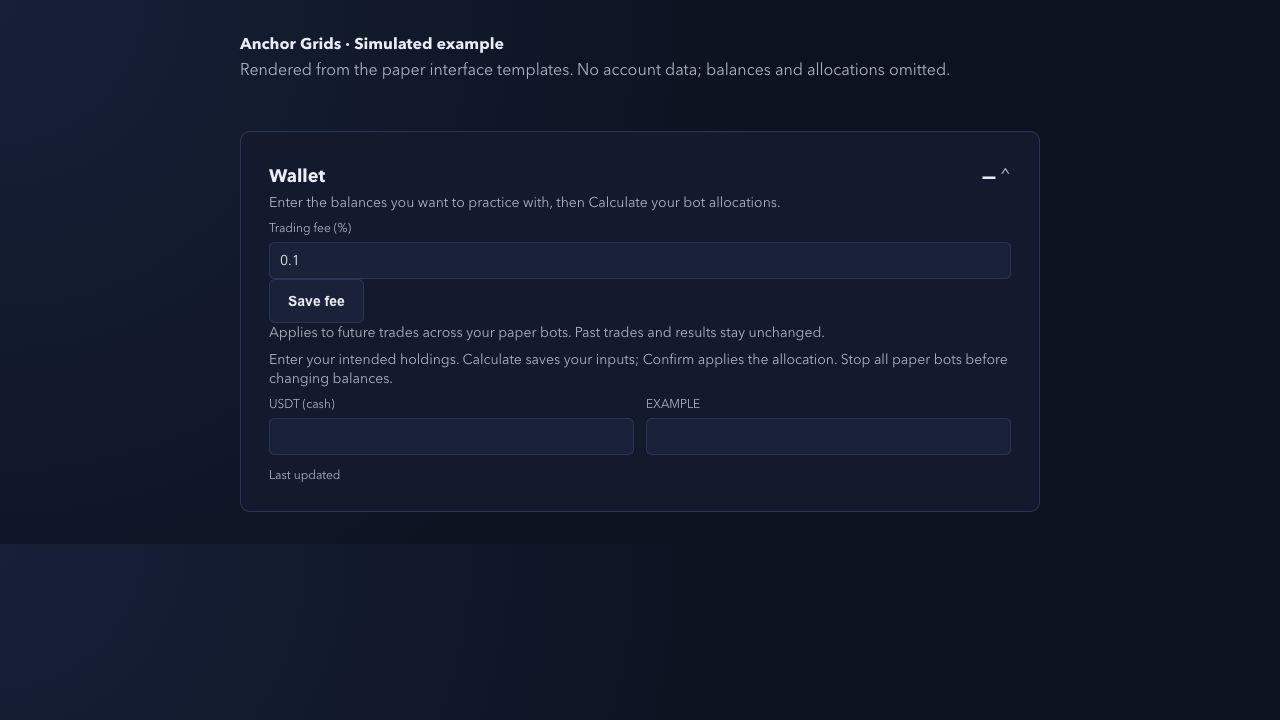
In the paper Bridge, enter your intended holdings in the Wallet and review your bot allocations in the Calculator. Stop all paper bots before changing balances. Calculate saves the inputs; Confirm applies the allocation.
Review the simulated trading fee
The paper Wallet lets you set a trading fee percentage. The saved rate applies to future trades across your paper bots; changing it does not rewrite past trades or results.
How the paper grid execution model fills orders
The current paper grid engine fills a buy when the observed ask reaches or falls below its order price, and a sell when the observed bid reaches or rises above it. A simulated fill completes the remaining quantity. The engine adjusts the observed execution price by 0.05% against the trade: higher for buys, lower for sells. It then applies your saved paper trading fee. This simplified model does not reproduce exchange queue priority, available order-book depth, or live partial fills.
Worked example: a simulated buy and its fee
For illustration, suppose a paper grid buy fills one unit at an observed ask of $100 and you set a 0.1% trading fee. The 0.05% execution adjustment makes the simulated price $100.05. The fee is $0.10005, so the total simulated quote cost is $100.15005. These are invented inputs explaining the calculation, not an actual trade or a performance result. The paper subscription charge is separate from this simulated trading fee.
Understand your paper slots
Each saved paper bot occupies one paper slot, even when stopped. Deleting a saved bot frees its slot. Check the current plans for paper capacity and the paper slot included with the live bundle.
Compare current plansPaper results are not a promise of live returns
Live trading uses real funds and can lose money. Treat paper practice as a way to learn the workflow, not proof of profitability. Do not assume simulated execution reproduces live liquidity, slippage, or exchange outages.
Product facts reviewed 2026-10-07. Source-linked public facts. Check current plans for beta billing terms.